Raja Ampat’s Coral Reefs: The World’s Richest
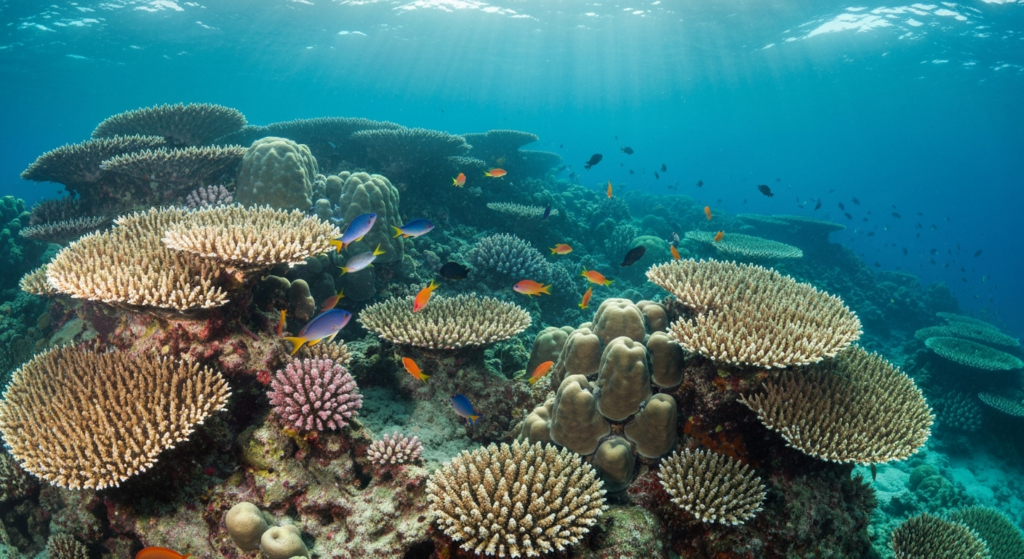
Raja Ampat’s coral reefs represent nothing less than the pinnacle of reef evolution on planet Earth. With over 600 species of hard (scleractinian) coral documented across the archipelago—approximately 75% of all coral species known to science—these reefs contain more coral diversity in a single region than entire ocean basins elsewhere. To put this in perspective, the entire Caribbean Sea supports roughly 65 coral species, while a single reef in Raja Ampat may host 200 or more. This extraordinary richness makes Raja Ampat the undisputed global capital of coral diversity, a living museum of reef biology that scientists travel from every continent to study.
What distinguishes Raja Ampat’s reefs beyond raw species counts is their remarkable health and vitality. While coral reefs worldwide face unprecedented threats from climate change, pollution, and overfishing—with global coral cover declining by roughly 50% since the 1950s—Raja Ampat’s protected reefs continue to thrive. Scientific monitoring consistently records coral cover exceeding 70% at many sites, with some locations approaching 90% living coral coverage. This resilience is attributed to a combination of factors: effective marine protection, favorable oceanographic conditions including deep-water upwellings that moderate temperature extremes, and the sheer genetic diversity that provides natural resistance to stressors.

Types of Coral Environments
Shallow Reef Flats
Sun-drenched platforms at 1-5 meters depth teeming with branching staghorn corals, massive Porites boulders centuries old, and brain corals. Accessible to snorkelers and home to juvenile reef fish, giant clams, and sea cucumbers.
Wall & Drop-off Reefs
Dramatic vertical walls plunging from shallow reef crests into deep blue water. Encrusted with gorgonian sea fans spanning 2+ meters, black coral forests, and fluorescent soft corals. Sites like Cape Kri and Melissa’s Garden exemplify this habitat.
Current-Swept Channels
Narrow passages between islands where tidal currents deliver nutrient-rich water. Corals here grow in streamlined forms adapted to flow. Attracts pelagic species including manta rays and sharks. The Dampier Strait epitomizes this environment.
Hard Coral Diversity: A Living Encyclopedia
Raja Ampat’s hard coral diversity reads like an encyclopedia of reef-building organisms. The massive Porites corals found throughout the archipelago include individual colonies estimated at 500+ years old—living organisms that were already growing when European explorers first sailed these waters. These ancient boulders serve as foundation structures for entire reef ecosystems, providing substrate, shelter, and habitat complexity that supports thousands of associated species.
Branching Acropora corals—the fastest-growing reef builders—form vast thickets in shallow, well-lit waters. Raja Ampat hosts dozens of Acropora species, from delicate finger corals to robust staghorn formations that create intricate three-dimensional structures teeming with damselfish, gobies, and tiny crustaceans. Table corals extend horizontal platforms that can exceed three meters in diameter, creating shaded habitats underneath where nocturnal species shelter during daylight hours.
The deeper reef zones reveal another dimension of coral diversity. Plate corals adapted to low-light conditions extend thin, flat colonies that maximize light capture efficiency. Mushroom corals—free-living species that sit unattached on the sea floor—demonstrate remarkable mobility, using their tissue to slowly right themselves if overturned. Cup corals, wire corals, and various encrusting species add complexity to every available surface, ensuring that virtually no square centimeter of reef substrate remains uncolonized.
Soft Coral Spectacles
While hard corals build the structural framework of Raja Ampat’s reefs, the soft corals provide the color palette that makes these underwater landscapes unforgettable. Dendronephthya soft corals—delicate, tree-like organisms in fluorescent pinks, purples, oranges, and reds—flourish in current-swept areas where water flow delivers the planktonic food particles they depend on. Sites like Boo Windows in Misool present underwater gardens so intensely colorful that they seem almost artificial, yet this kaleidoscopic display is entirely natural.
Gorgonian sea fans represent another soft coral highlight. These flattened, fan-shaped colonies orient themselves perpendicular to prevailing currents, creating natural nets that filter plankton from the water. Raja Ampat’s sea fans can exceed two meters in height and width, their intricate lattice patterns hosting pygmy seahorses, basket stars, and tiny commensal shrimps that are almost invisible against the fan’s surface. Photographers seeking these cryptic creatures spend entire dives examining single sea fans, discovering new hidden residents with each careful inspection.
Reef Health & Resilience
Raja Ampat’s reefs have demonstrated remarkable resilience in the face of global coral bleaching events. During the catastrophic 2016 global bleaching event—triggered by a powerful El Niño that devastated reefs across the tropics—Raja Ampat experienced significantly less bleaching than many comparable Indo-Pacific reef systems. Scientists attribute this resilience to several factors: deep-water upwellings that moderate surface temperatures during heat stress events, strong currents that prevent thermal stratification, high genetic diversity within coral populations providing natural stress resistance, and the overall health of reef ecosystems maintained through effective marine protection.
Ongoing monitoring programs track coral health indicators including live coral cover, recruitment rates (new coral settlement), species diversity, and disease prevalence. These long-term datasets demonstrate that Raja Ampat’s protected reefs are not only maintaining their current condition but in many areas actively recovering from historical damage caused by blast fishing and other destructive practices that occurred before marine protection was established. The recovery trajectory provides compelling evidence that effective conservation can reverse reef degradation even in an era of global environmental change.
Frequently Asked Questions
Why does Raja Ampat have the most coral species in the world?
Raja Ampat sits at the center of the Coral Triangle where Pacific and Indian Ocean coral fauna overlap. Complex topography creates diverse habitats from shallow reef flats to deep walls, supporting species with different ecological requirements. Favorable currents, stable tropical temperatures, and effective marine protection maintain conditions allowing maximum coral diversity to persist and flourish.
What is the best way to see Raja Ampat’s coral reefs?
Both snorkeling and scuba diving offer exceptional coral reef experiences. Snorkeling provides access to stunning shallow reef flats with excellent coral diversity at sites like Arborek, Friwen Wall, and Sawandarek jetty. Scuba diving reveals deeper reef environments including dramatic walls and current-swept channels. Liveaboard trips provide the widest access to diverse reef types across the archipelago.
Are Raja Ampat’s coral reefs affected by bleaching?
Raja Ampat’s reefs have shown remarkable resilience to global bleaching events compared to many other reef systems. During the 2016 global bleaching event, Raja Ampat experienced less severe bleaching than the Great Barrier Reef or many Maldivian reefs. Deep-water upwellings, strong currents, and high genetic diversity provide natural buffers against thermal stress, though climate change remains a long-term concern.
Can beginners enjoy the coral reefs?
Absolutely. Many of Raja Ampat’s most spectacular coral gardens are accessible in shallow water (1-5 meters) perfect for beginner snorkelers. House reefs at resorts and homestays like Arborek and Kri offer easy, current-free access to diverse coral formations. For diving, numerous sites have gentle conditions suitable for newly certified divers, with more challenging current-swept sites available for advanced divers.
Explore the World’s Richest Coral Reefs
Dive and snorkel among 600+ coral species with our expert marine guides.