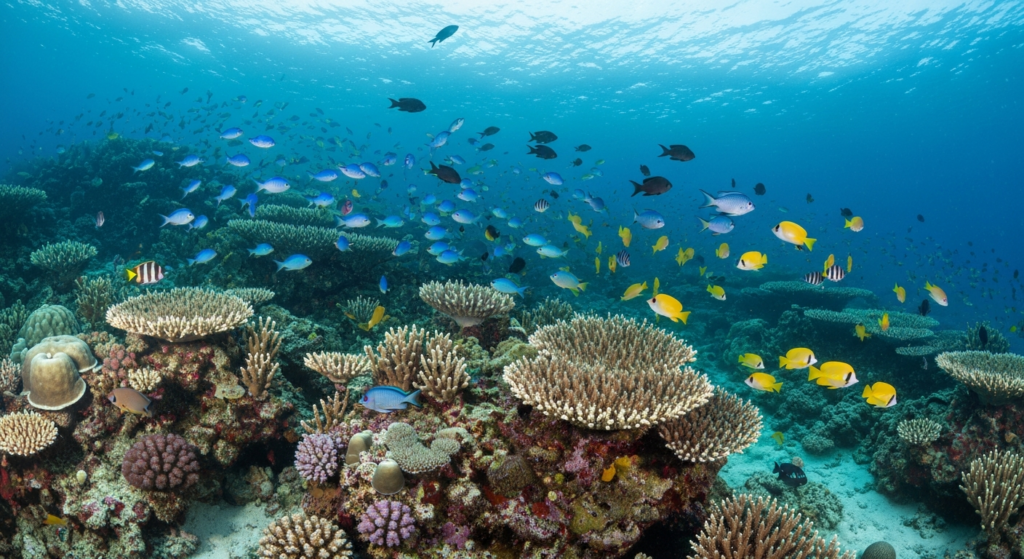
Raja Ampat: The Epicenter of Global Marine Biodiversity
Raja Ampat holds a distinction unmatched anywhere on the planet—it is the single richest marine ecosystem ever documented by science. Located at the heart of the Coral Triangle, often called the “Amazon of the Seas,” this archipelago supports more marine species per unit area than any other place on Earth. The numbers are staggering: over 1,700 reef fish species (representing more than the entire Atlantic Ocean combined), 600+ hard coral species (approximately 75% of all known coral species worldwide), 700+ mollusk species, and an uncounted wealth of crustaceans, echinoderms, and marine invertebrates still being cataloged by researchers.
This extraordinary biodiversity is not merely an academic statistic—it creates the visual spectacle that draws divers and marine enthusiasts from every corner of the globe. A single dive in Raja Ampat reveals a density of life that overwhelms the senses: reef walls carpeted in soft corals of every color imaginable, schools of fish so dense they block sunlight, sea fans taller than humans swaying in gentle currents, and an endless parade of creatures from the microscopic to the magnificent. Scientists have recorded 374 fish species on a single dive at Cape Kri—a world record that has stood for over two decades and may never be surpassed.

Why Raja Ampat Is So Biodiverse
Raja Ampat’s unparalleled biodiversity results from a convergence of geological history, oceanographic conditions, and geographic position that cannot be replicated anywhere else. During the ice ages, when sea levels dropped dramatically, the shallow Sahul and Sunda continental shelves were exposed, creating land bridges that isolated marine populations. As seas rose again, these populations reconnected, blending species assemblages from the Pacific and Indian Oceans into one extraordinarily diverse melting pot. Raja Ampat sits precisely at this crossroads—the meeting point where Pacific and Indian Ocean species overlap.
The archipelago’s complex topography creates an astonishing variety of marine habitats within a relatively compact area. Deep oceanic trenches plunging to over 4,000 meters lie within kilometers of shallow coral flats. Powerful currents racing through narrow straits create nutrient upwellings that fuel extraordinary productivity, while sheltered bays and lagoons provide calm nursery habitats for juvenile fish and invertebrates. Mangrove forests, seagrass meadows, and coral reefs exist in close proximity, forming interconnected ecosystems that support species through different life stages.
Flagship Species
Reef Manta Rays
Raja Ampat hosts one of the world’s largest populations of reef manta rays (Mobula alfredi). Cleaning stations at Manta Sandy and Eagle Rock provide reliable encounters year-round, with mantas spanning up to 5 meters.
Walking Sharks
Raja Ampat is home to several endemic epaulette shark species that literally walk across reef flats using modified pectoral fins. These unique sharks, discovered here, are found nowhere else on Earth—a powerful symbol of the region’s evolutionary uniqueness.
Wilson’s Bird-of-Paradise
One of the world’s rarest and most beautiful birds, Wilson’s Bird-of-Paradise is found only on Waigeo and Batanta islands. Males display iridescent blue, red, and yellow plumage in elaborate courtship dances on carefully prepared forest stages.
Coral Diversity: 75% of All Known Species
Raja Ampat’s coral reefs represent the pinnacle of reef diversity on the planet. With over 600 species of hard (scleractinian) coral documented—approximately 75% of all known coral species globally—the archipelago serves as a living library of coral evolution. This diversity is visible to even casual snorkelers: massive boulder corals centuries old share reef space with delicate branching staghorns, plate corals extending like shelves from reef walls, and brain corals whose labyrinthine surfaces host tiny commensal creatures.
Soft corals add another dimension of color and complexity. Raja Ampat’s current-swept walls and overhangs support spectacular gardens of gorgonian sea fans, dendronephthya soft corals in fluorescent pinks, purples, and oranges, and black coral forests that provide habitat for seahorses, nudibranchs, and tiny crustaceans. The Misool region is particularly celebrated for its soft coral abundance—dive sites like Boo Windows and Nudi Rock present underwater landscapes that resemble abstract paintings in their intensity of color and form.
Fish Diversity: World Record Holder
The fish diversity of Raja Ampat defies superlatives. Beyond the famous 374-species record at Cape Kri, survey after survey has confirmed that Raja Ampat supports more reef fish species than any other location on Earth. This includes representatives from nearly every tropical fish family—from tiny pygmy seahorses smaller than a fingernail to oceanic manta rays spanning five meters, from camouflaged frogfish lurking motionless on sponges to massive Napoleon wrasses patrolling reef drop-offs.
Schooling fish create some of Raja Ampat’s most breathtaking spectacles. At sites like Sardine Reef in the Dampier Strait, vast shoals of fusiliers, surgeonfish, and jacks form swirling silver walls that envelope divers in a living cathedral of movement. Predators including barracuda, trevally, and grey reef sharks patrol the edges of these aggregations, creating dynamic predator-prey interactions that unfold in real-time before astonished observers. Night dives reveal an entirely different community—flashlight fish with bioluminescent organs, hunting lionfish, and the emergence of countless invertebrates that hide during daylight hours.
Endemic Species & Scientific Discovery
Raja Ampat continues to yield new species discoveries at a remarkable rate. In recent decades, scientists have described multiple species previously unknown to science from these waters, including several epaulette shark species, nudibranchs, and reef fish. The walking sharks of Raja Ampat—small, bottom-dwelling sharks that use their pectoral fins to walk across shallow reef flats—have become powerful ambassadors for the region’s evolutionary significance, demonstrating that these waters have been generating unique life forms for millions of years.
On land, the biodiversity story continues with remarkable avian diversity. Raja Ampat’s forests shelter two endemic bird-of-paradise species—Wilson’s Bird-of-Paradise and the Red Bird-of-Paradise—along with numerous parrots, kingfishers, and hornbills. The islands also support cuscus (arboreal marsupials), tree kangaroos on the larger islands, and a rich herpetofauna including endemic lizards and frogs still being cataloged by researchers.
Frequently Asked Questions
Why is Raja Ampat the most biodiverse place in the ocean?
Raja Ampat’s extraordinary biodiversity results from its position at the heart of the Coral Triangle, where Pacific and Indian Ocean species overlap. Complex topography creates diverse habitats from deep trenches to shallow lagoons, while powerful currents deliver nutrients supporting incredible productivity. Geological history—including ice age isolation and reconnection of marine populations—further enriched species diversity over millions of years.
How many species live in Raja Ampat?
Raja Ampat is home to over 1,700 fish species, 600+ coral species (75% of global coral diversity), 700+ mollusk species, and thousands of invertebrates. On land, the forests support endemic birds-of-paradise, cuscus, and diverse reptiles. New species continue to be discovered regularly, suggesting the true count is significantly higher than current records.
What unique animals can I see only in Raja Ampat?
Several species are found only in Raja Ampat, including multiple endemic epaulette (walking) shark species, Wilson’s Bird-of-Paradise (restricted to Waigeo and Batanta), and various fish and invertebrate species. The walking sharks are particularly iconic—small sharks that use modified fins to walk across shallow reefs, found nowhere else on Earth.
What is the Coral Triangle?
The Coral Triangle is a roughly triangular area of tropical Pacific Ocean encompassing waters of Indonesia, Philippines, Malaysia, Papua New Guinea, Timor-Leste, and Solomon Islands. It contains the highest marine biodiversity on Earth—over 30% of all reef fish species and 76% of all known coral species. Raja Ampat sits at its absolute center, making it the most biodiverse point within the most biodiverse marine region.
Witness Earth’s Richest Marine Ecosystem
Experience the unmatched biodiversity of Raja Ampat with expert guides who know every reef.