Fish Species of Raja Ampat: 1,700+ and Counting
Raja Ampat’s fish diversity is simply without parallel anywhere on Earth. With over 1,700 reef fish species documented and new species still being discovered, the archipelago supports more fish diversity than entire oceans—the Atlantic Ocean in its entirety hosts fewer reef fish species than this single Indonesian archipelago. This remarkable concentration of ichthyological diversity transforms every dive and snorkeling session into a masterclass in tropical fish biology, where the sheer abundance and variety of fish life creates scenes of underwater splendor that define the very concept of a healthy reef ecosystem.
The world record for fish species diversity was set at Cape Kri in Raja Ampat’s Dampier Strait, where marine biologist Dr. Gerald Allen counted an astonishing 374 species during a single 90-minute dive—a record that has stood since 2012 and may never be surpassed. To appreciate the magnitude of this achievement, consider that the entire Great Barrier Reef—stretching over 2,300 kilometers—hosts approximately 1,500 fish species, while a single reef in Raja Ampat can reveal nearly a quarter of that total in one dive session.

Iconic Fish Encounters
Walking Sharks (Endemic)
Several species of epaulette sharks found ONLY in Raja Ampat literally walk across reef flats using modified pectoral fins. Best seen on night dives in shallow water. These endemic species symbolize Raja Ampat’s evolutionary uniqueness.
Pygmy Seahorses
Multiple pygmy seahorse species inhabit Raja Ampat’s gorgonian sea fans. At less than 2cm long, these perfectly camouflaged creatures are a holy grail for macro photographers. Denise’s and Bargibant’s pygmy seahorses are regularly found by expert guides.
Schooling Spectacles
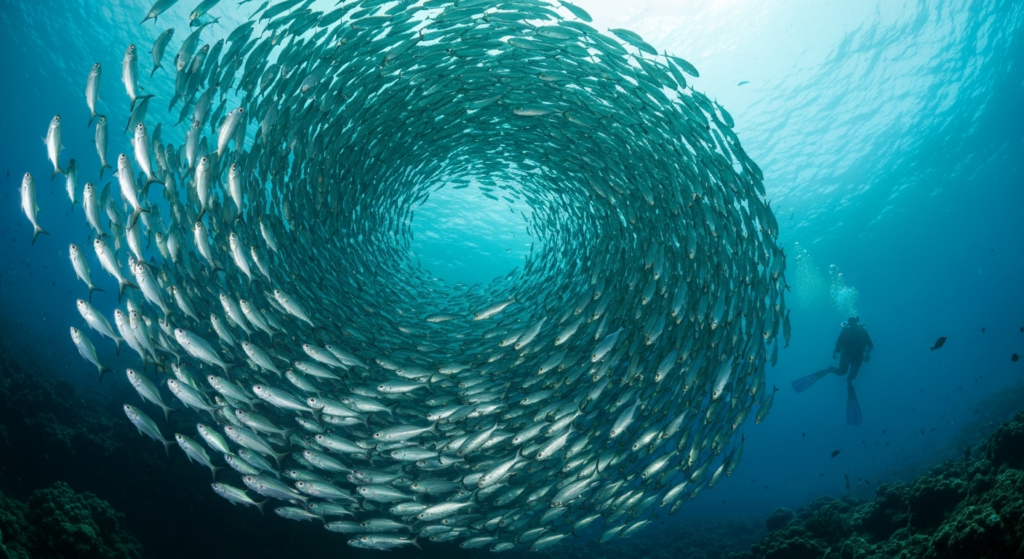
Sardine Reef hosts millions of fusiliers creating silver walls. Schools of chevron barracuda form mesmerizing vortexes. Bumphead parrotfish herds of 50+ graze coral at dawn. Big-eye trevally form tornado-like columns at Blue Magic.
Predator Species
Raja Ampat’s healthy, protected reefs support robust predator populations that have been decimated in most other tropical regions. Grey reef sharks patrol drop-off edges in groups, their sleek silhouettes cruising the blue water just beyond the reef wall. Blacktip and whitetip reef sharks are common in shallower waters, often resting in caves during the day and emerging at dusk to hunt. The Dampier Strait’s nutrient-rich currents attract larger pelagic predators including dog-tooth tuna, giant trevally exceeding 40 kilograms, and occasional hammerhead sharks that drift through deeper channels.
Napoleon wrasses—the gentle giants of the reef fish world—are a hallmark of healthy, well-protected reef ecosystems. These massive wrasses, which can exceed two meters in length and live for over 30 years, have been hunted to rarity throughout most of Southeast Asia for the luxury live fish trade. In Raja Ampat’s protected waters, they thrive, approaching divers with characteristic curiosity. Their presence in significant numbers is one of the clearest indicators that Raja Ampat’s marine protection is working—these slow-growing, late-maturing fish are among the first species to disappear under fishing pressure and among the last to recover.
Wobbegong sharks—bizarre, flat-bodied ambush predators covered in ornate camouflage patterns—are a Raja Ampat specialty. Found resting under coral ledges and table corals, these master camoufleurs wait motionlessly for prey to wander within striking distance. Several wobbegong species occur in Raja Ampat, including endemic forms found nowhere else, making them priority targets for underwater photographers seeking unique wildlife encounters.
Macro Life & Critter Diving
While Raja Ampat’s big-animal encounters steal headlines, the archipelago’s macro life is equally extraordinary. The term “critter diving” was practically invented in this part of the world, where patient observation of seemingly barren rubble patches reveals a hidden universe of bizarre and beautiful miniature creatures. Ornate ghost pipefish hover motionless alongside crinoid feather stars, their body shapes and colors perfectly mimicking the host animal. Mimic octopuses transform their bodies to resemble lionfish, flatfish, or sea snakes depending on which predator threatens them—a behavioral repertoire that challenges our understanding of invertebrate intelligence.
Nudibranchs—shell-less marine snails in psychedelic color combinations—are represented by hundreds of species in Raja Ampat. From the massive Spanish dancer that unfurls crimson tissue while swimming to tiny species smaller than a grain of rice, these gem-like creatures reward slow, careful observation. Mantis shrimps, with their incredible striking power and complex color vision, peer from burrows with stalked eyes that process more visual information than any other animal. Frogfish—blob-like ambush predators that can change color over days—lurk on sponges, using modified dorsal fins as fishing lures to attract unsuspecting prey.
Night Diving Revelations
After dark, Raja Ampat’s reefs transform into an entirely different ecosystem as nocturnal species emerge and diurnal fish retreat to sleeping positions. Night dives reveal walking sharks patrolling shallow reef flats on their modified fins, hunting sleeping fish with methodical precision. Cuttlefish display mesmerizing color changes as they hunt—their skin rippling with waves of color that serve as both communication and hunting camouflage. Basket stars, coiled into tight balls during daylight, unfurl elaborate branching arms spanning half a meter to filter-feed in the current.
Fluorescence diving—using ultraviolet lights and special filter masks—reveals yet another hidden dimension of Raja Ampat’s reefs. Under UV illumination, certain corals, anemones, and marine organisms glow in brilliant greens, oranges, and reds, creating an otherworldly landscape that reveals biological processes invisible to normal vision. This emerging specialty diving technique is offered by a growing number of Raja Ampat operators and provides an unforgettable perspective on reef biology.
Frequently Asked Questions
What is the most fish species ever seen on one dive in Raja Ampat?
The world record of 374 fish species on a single dive was set at Cape Kri in Raja Ampat’s Dampier Strait by Dr. Gerald Allen. This record has stood since 2012 and represents more species diversity in one 90-minute dive than many entire reef systems support. Cape Kri remains one of the world’s premier dive sites for fish diversity.
What are walking sharks and where can I see them?
Walking sharks are endemic epaulette shark species that use their pectoral fins to walk across shallow reef flats, primarily at night. Several species found only in Raja Ampat were described by scientists in recent decades. Night dives at shallow reef sites offer the best chances for encounters, with experienced guides knowing specific locations where they regularly hunt.
Do I need to be an experienced diver to see the best fish life?
Many of Raja Ampat’s most spectacular fish encounters are accessible to snorkelers and beginner divers. House reefs at sites like Arborek and Kri offer incredible fish diversity in just 2-5 meters of water. Schooling fish spectacles, walking sharks on night snorkels, and manta ray encounters at Eagle Rock are all accessible without advanced diving certification.
What fish species are unique to Raja Ampat?
Several species are endemic to Raja Ampat or the Bird’s Head Seascape region, including multiple walking shark (epaulette shark) species, the Raja Ampat flasher wrasse, and various gobies, blennies, and dottybacks. New species continue to be described regularly, and many reef organisms found here have not yet been formally named by science.
Discover 1,700+ Fish Species
Dive the world’s most biodiverse waters with guides who know every species.