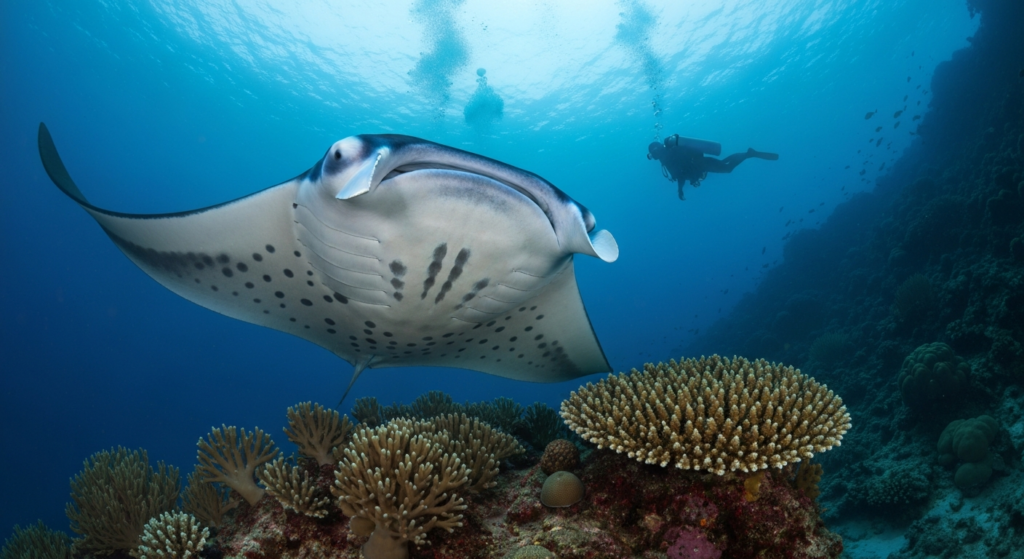
Manta Ray Encounters in Raja Ampat
Few wildlife encounters rival the majesty of swimming alongside a manta ray in Raja Ampat’s crystal-clear waters. These gentle giants, with wingspans reaching up to five meters, glide through the ocean with an effortless grace that leaves divers and snorkelers awestruck. Raja Ampat hosts one of the largest and best-studied populations of reef manta rays (Mobula alfredi) in the world, with over 300 individuals identified through their unique belly spot patterns—essentially fingerprints that allow researchers to track each animal throughout its lifetime.
What makes Raja Ampat exceptional for manta encounters is the predictability and accessibility of sightings. Unlike many manta destinations where encounters depend on seasonal migrations and uncertain conditions, Raja Ampat’s resident population frequents established cleaning stations year-round. These cleaning stations—specific reef formations where small cleaner fish remove parasites from visiting mantas—serve as underwater meeting points where multiple mantas congregate daily, sometimes in groups of ten or more, providing extended observation opportunities unavailable almost anywhere else.

Best Manta Ray Sites
Manta Sandy
The most famous manta cleaning station in Raja Ampat. Located in the Dampier Strait at 12-17 meters depth, this sandy bottom site hosts daily manta visits. Divers kneel on the sand and watch mantas circle overhead in mesmerizing patterns. Up to 20+ mantas recorded simultaneously.
Eagle Rock (Manta Ridge)
A shallow cleaning station at 5-8 meters depth, making it accessible to snorkelers as well as divers. Located near Arborek village, Eagle Rock features a coral ridge where mantas hover while cleaner wrasses work. Exceptional for photography with natural lighting.
Wayag & Kawe
Northern Raja Ampat sites where oceanic manta rays (Mobula birostris) are occasionally encountered. These larger cousins can exceed 7 meters wingspan. Encounters are less predictable but absolutely spectacular when they occur during plankton-rich periods.
Understanding Manta Ray Behavior
Manta rays are among the most intelligent of all fish species, possessing the largest brain-to-body ratio of any cold-blooded fish. They demonstrate remarkable individual personalities—some mantas are curious and approach divers closely, while others maintain a respectful distance. Researchers in Raja Ampat have documented complex social behaviors including cooperative feeding, apparent play behavior, and long-term associations between specific individuals who are repeatedly observed together over years of monitoring.
At cleaning stations, mantas enter a near-hypnotic state as they slow their swimming to allow cleaner fish—primarily wrasses and small gobies—to remove parasites, dead skin, and mucus from their bodies. During these cleaning sessions, mantas may circle the same station for 30 minutes or more, providing extraordinary extended encounters for patient observers. The relationship between mantas and cleaner fish is one of nature’s finest examples of mutualism—the cleaners receive a meal while the mantas maintain their health.
Feeding behavior creates some of Raja Ampat’s most dramatic manta spectacles. When plankton concentrations peak—typically during current changes and monsoon transitions—mantas engage in barrel-rolling feeding spirals, somersaulting repeatedly through dense plankton clouds with mouths agape. Chain feeding, where multiple mantas line up nose-to-tail swimming in tight circles, concentrates plankton and allows the group to feed more efficiently than individuals—a sophisticated collective foraging strategy rarely witnessed elsewhere.
Best Time to See Mantas
While Raja Ampat’s resident manta population can be encountered year-round, conditions vary seasonally. The peak season runs from November through April, coinciding with the northwest monsoon when plankton productivity peaks in the Dampier Strait. During this period, multiple mantas frequently congregate at cleaning stations, and feeding aggregations are more common. Water temperatures around 28-30°C and visibility of 15-25 meters create ideal conditions for both diving and photography.
The dry season from May through October offers fewer guaranteed manta encounters at the main cleaning stations, but compensates with generally better visibility and calmer surface conditions. Mantas don’t disappear during this period—they may shift to different feeding areas or visit cleaning stations less frequently. Experienced guides who know the local patterns can often find mantas at alternative sites during the dry season, and encounters tend to be more intimate with fewer divers present.
Manta Conservation & Research
Raja Ampat plays a critical role in global manta ray conservation. Indonesia declared full protection for all manta ray species in 2014, establishing the world’s largest manta ray sanctuary covering 5.8 million square kilometers of ocean. Within Raja Ampat, dedicated research programs led by organizations including the Manta Trust and local conservation groups maintain a comprehensive photo-identification database, tracking individual mantas over their lifetimes to understand population dynamics, movement patterns, and reproductive rates.
Every diver and snorkeler in Raja Ampat can contribute to manta conservation through citizen science. By photographing manta belly patterns and submitting images to the Manta Trust’s ID database, visitors help researchers track individual animals and monitor population health. Strict codes of conduct at cleaning stations—maintaining minimum distances, avoiding flash photography, not touching mantas, and limiting group sizes—ensure that tourism interactions don’t disturb natural behaviors or drive mantas away from essential cleaning sites.
Frequently Asked Questions
What is the best time to see manta rays in Raja Ampat?
Manta rays can be seen year-round in Raja Ampat, with peak season from November to April when plankton blooms attract larger aggregations. During peak months, 10-20+ mantas may visit cleaning stations daily. Even during the May-October dry season, individual mantas regularly visit established sites, though aggregations are smaller.
Can I snorkel with manta rays or do I need to dive?
Yes, snorkeling with mantas is excellent at Eagle Rock (Manta Ridge), where the cleaning station sits at just 5-8 meters depth. Mantas frequently approach the surface within arm’s reach of snorkelers. Manta Sandy requires diving (12-17m depth). Both experiences are extraordinary, though diving allows longer observation times.
Are manta rays dangerous to swim with?
Manta rays are completely harmless to humans. They have no stinging barb (unlike stingrays), no teeth capable of biting humans, and are gentle, curious creatures that often approach divers voluntarily. The only precaution needed is avoiding touching them, which can remove their protective mucus coating and cause stress.
How big are Raja Ampat’s manta rays?
Raja Ampat’s resident reef mantas (Mobula alfredi) typically reach 3-5 meters wingspan, with some individuals exceeding 5 meters. Oceanic mantas (Mobula birostris), occasionally seen in northern Raja Ampat, can exceed 7 meters wingspan. Despite their impressive size, mantas are filter feeders that subsist entirely on tiny plankton and small fish.
Swim with Majestic Manta Rays
Book a manta ray dive or snorkel excursion with our expert marine guides.